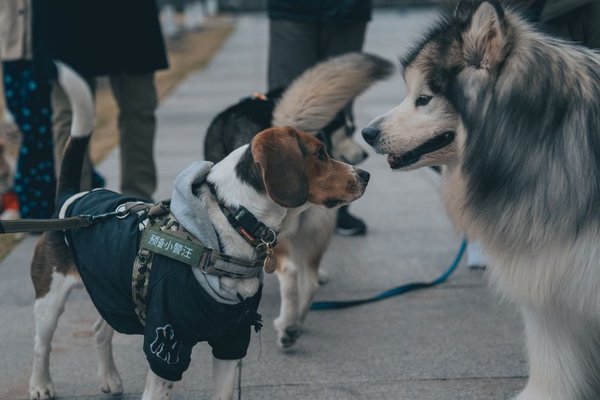
Socialising a reactive dog is not about making them greet every person or dog they see. The goal is to help them feel safer, recover more quickly and make calmer choices around triggers. Success may mean calmly watching another dog from across a field or choosing to disengage instead of barking and lunging.
Reactivity can come from fear, frustration, over-excitement, pain or previous experiences. Because the emotion underneath matters, safe progress starts with management and distance rather than forced exposure.
Understand what your dog is reacting to
Identify the pattern. Does your dog react to all dogs, only dogs approaching head-on, strangers, bicycles, children, visitors or certain noises? Note what happened, how far away the trigger was and how quickly your dog recovered.
Watch body language before the barking begins. Staring, a closed mouth, stiff posture, leaning forward, trying to hide, refusing food or sudden scanning can signal rising stress. Recognising these earlier signs gives you time to create distance before your dog is overwhelmed.
Find your dog’s workable distance
Dog reactivity training works best when the dog notices a trigger but is still able to think, eat and respond. This is often described as staying under threshold. The workable distance can change with the environment, the trigger and the dog’s stress level.
If your dog cannot take a favourite treat, cannot look away or is already barking and lunging, move farther away. Distance is not failure; it is one of the most useful training tools you have.
Pair the trigger with something positive
Once you are far enough away for your dog to remain reasonably calm, let them notice the trigger and immediately provide something they value, such as a small piece of food. With repetition, the appearance of another dog or person can begin to predict something good rather than danger or frustration.
This process should be gradual. Current veterinary behaviour guidance supports reward-based methods and systematic desensitisation rather than aversive training or overwhelming exposure. The aim is to change the dog’s emotional response, not simply suppress visible behaviour.
Teach an easy way to disengage
Practise simple behaviours at home or in a quiet area: responding to their name, turning with you, following a hand target, searching the ground for treats or making brief eye contact.
On a walk, these skills give you options. If another dog appears unexpectedly, turn away, move behind a parked car or cross the road while rewarding your dog for coming with you. Dogs Trust recommends creating enough distance, using visual barriers where useful and rewarding calm or attention rather than telling a reactive dog off.
Handle leash reactivity without adding pressure
Leash reactivity is common because a lead removes the option to move away freely. Some dogs feel trapped, while others become frustrated because they cannot approach. A tight lead, repeated corrections or dragging the dog closer can increase tension.
Use secure, comfortable walking equipment and give your dog as much space as the environment safely allows. Choose wider routes with good visibility and several exit options. Walking at quieter times can reduce surprise encounters while your dog is learning.
Do not force dog-to-dog greetings
A reactive dog does not need direct greetings to become more comfortable around other dogs. Repeated close encounters can slow progress if the dog is frightened or over-aroused.
A better exercise is a parallel walk with a calm, suitable dog. Begin far apart and walk in the same direction rather than approaching face-to-face. If both dogs remain relaxed, the distance can gradually decrease over several sessions. There is no requirement to end with nose-to-nose contact.
Approach fearful dog socialization differently
For fearful dog socialization, choice matters. Ask visitors to ignore the dog rather than reaching toward them. Give the dog access to a safe area and allow them to approach voluntarily. A guest can gently toss treats away from themselves so the dog can collect food without being pulled into unwanted contact.
Do not lure a frightened dog close with food and then touch them. The dog may want the treat while still feeling unsafe about the person.
Use short sessions and allow recovery time
More exposure is not always better. Several difficult encounters in one walk can leave a dog more sensitive. Short, successful sessions followed by rest are often more productive.
For example, if your dog reacts to other dogs at about 20 metres, avoid walking through a busy park. Work from farther away, reward calm observation of two or three dogs, then leave while the session is still going well. Repeating manageable experiences is more useful than waiting for a major reaction.
Avoid punishment and corrections
Shouting, leash jerks, choke chains, prong collars or electronic collars may interrupt behaviour, but they can make the trigger feel even more unpleasant. The American Veterinary Society of Animal Behavior recommends reward-based training for behaviour problems and advises against aversive methods.
Growling should not be punished either. It communicates discomfort. Removing the warning without addressing the emotion can make future behaviour harder to predict.
Know when professional help is needed
Seek professional support if your dog has bitten, attempted to bite, redirects onto the handler, cannot recover after triggers or is becoming more reactive despite careful management. Sudden behaviour changes also warrant a veterinary check because pain or illness can contribute to reactivity.
A qualified reward-based trainer may help with straightforward cases, while significant fear, anxiety or aggression may need a clinical animal behaviourist or veterinary behaviour professional. Positive muzzle training can also be part of a sensible safety plan when appropriate.
Frequently asked questions
Can a reactive dog ever become social?
Many reactive dogs improve greatly, but the goal should be comfort and safe behaviour rather than making every dog highly social. Some will always prefer more personal space.
Should I take my reactive dog to a dog park?
Usually not as a training exercise. Uncontrolled close interactions make distance difficult to manage and can overwhelm a reactive dog. Structured exposure in a predictable setting is safer.
How quickly should I reduce the distance to a trigger?
Only when your dog is consistently relaxed and able to eat, disengage and respond at the current distance. Increase distance again when needed.
Is barking at another dog always aggression?
No. Barking and lunging can come from fear, frustration, excitement or attempts to create distance. Understanding the emotion helps determine the right plan.
Make safety and calm the measure of progress
Learning how to socialize a reactive dog safely means replacing forced contact with thoughtful exposure. Identify triggers, work at a distance your dog can handle, reward calm responses and give them reliable ways to move away. A dog who can notice a trigger and remain able to think is learning an important skill. Consistent reward-based practice and good management can gradually make everyday walks and social situations easier for both of you.