Finding a young bird on the ground can trigger an immediate urge to rescue it. Sometimes that instinct is useful, but just as often the safest choice is to step back. Many healthy young birds spend time outside the nest before they can fly well, and their parents may be watching, feeding, and calling to them from nearby.
The key is to work out whether you have found a nestling or a fledgling, then look for signs of injury or immediate danger. A quick, calm assessment can prevent a well-meaning baby bird rescue from separating a healthy youngster from the adults still caring for it.
First, decide whether it is a nestling or a fledgling
The difference between a nestling and a fledgling is more important than whether the bird is sitting on the ground. Being on the ground is abnormal for many nestlings, but normal for many fledglings.
What a nestling looks like
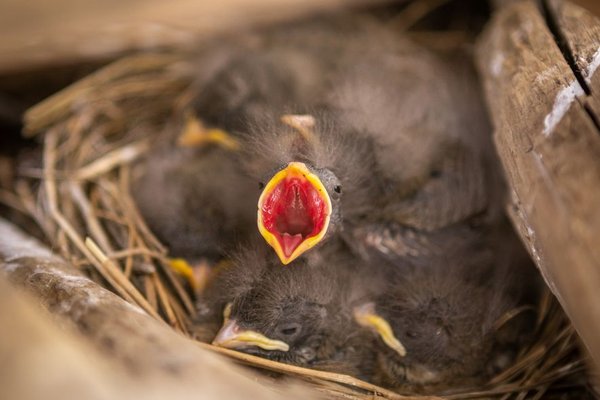
A nestling is a very young bird that is not ready to live outside the nest. It may be mostly bare, covered with sparse down, or have short developing feathers. Its eyes may be closed or only recently opened, and it usually cannot hop or grip a branch normally. If you find a baby bird that looks like this, it may have fallen or been displaced from its nest.
What a fledgling looks like
A fledgling is older and usually has most of its feathers. It may look scruffy, have a short tail, and hop, flutter, perch, or make short awkward flights. Fledglings often leave the nest before they are strong flyers. Their parents normally continue feeding them while they learn to move through nearby cover.
This nestling vs fledgling distinction prevents a common mistake: picking up a healthy fledgling because it appears too young to be alone.
If it is a healthy fledgling, usually leave it where it is
A feathered fledgling that can stand or hop and has no obvious injury usually does not need to be taken away. Give it space and watch from a distance. Parent birds may avoid approaching while a person, dog, or cat is close, so standing over the youngster can make it seem more abandoned than it is.
If the fledgling is in immediate danger, such as the middle of a road or a place where pets can reach it, move it only a short distance to nearby shelter. A low branch or dense shrub close to where it was found is often enough. Staying in the same area helps the parents locate and continue caring for it.
For example, if you find a feathered young robin hopping beside a driveway while an adult robin is calling from a fence, do not automatically put the youngster in a box. Keep pets indoors, move the bird into nearby cover only if traffic is a risk, then leave the area so the parent can return.
If it is a nestling, look for the nest
A healthy nestling on the ground generally needs help getting back into a nest. Look carefully in nearby trees, shrubs, ledges, or other likely nesting spots. Nests can be surprisingly well hidden.
If you can safely reach the correct nest, gently place the nestling back inside. The belief that parent birds will reject a chick because a person touched it is a myth. Brief handling to return a young bird to its nest is unlikely to cause abandonment.
If the nest cannot be found or safely restored, contact a wildlife rehabilitator or local wildlife authority for species-appropriate advice rather than attempting long-term care yourself.
Know when the bird needs professional help
Whether the bird is a nestling or fledgling, professional help is appropriate when there are clear signs of injury, illness, or dangerous exposure. Warning signs include active bleeding, a visibly broken or dangling wing or leg, inability to stand, severe weakness, repeated falling over, obvious breathing difficulty, or an attack by a cat or dog.
A bird that has been in a cat’s mouth should receive prompt professional attention even when wounds are not obvious. Small punctures can be difficult to see. Contact a licensed wildlife rehabilitator, veterinarian who handles wildlife, or the appropriate local wildlife service and follow their transport instructions.
Do not feed or give water unless a professional tells you to
Do not put food or water into a baby bird’s beak unless a qualified professional instructs you to. Different species have different diets, and the wrong food can cause harm. Giving water directly into the mouth can also be dangerous if liquid enters the airway.
If a rehabilitator advises temporary containment, follow those instructions closely. In many cases, quiet, safety, warmth appropriate to the situation, and minimal handling matter more than feeding.
Give the parents a fair chance to return
When a young bird appears uninjured, observe from far enough away that adults feel safe approaching. Keep children and pets back and avoid repeatedly walking up to check.
If you remain concerned that the parents are not returning, contact a wildlife rehabilitator for guidance based on the species, age, weather, location, and how long the bird has been unattended. Do not assume a chick is orphaned simply because no adult appears during a brief observation.
Related reading: backyard bird nesting season, safer outdoor spaces for wild birds, and preventing window collisions.
FAQ
Can I touch a baby bird without making its parents abandon it?
Yes. If a nestling needs to be returned to its nest or a fledgling must be moved a short distance out of immediate danger, brief handling will not normally cause the parents to reject it because of human scent.
Should I take a fledgling home if it cannot fly?
Usually not. Many fledglings leave the nest before they can fly strongly. If the bird is feathered, alert, able to hop or perch, and not visibly injured, its parents are likely still caring for it nearby.
What should I do if I cannot find the nest?
If the bird is a nestling and the nest cannot be located or safely restored, contact a wildlife rehabilitator or local wildlife authority for advice. Do not attempt to raise the bird yourself.
When should I contact a wildlife rehabilitator immediately?
Seek professional help if the bird is bleeding, appears to have a broken limb or wing, cannot stand, is unusually weak, has breathing trouble, or has been caught by a cat or dog. Call before transporting the bird whenever possible so you can follow the rehabilitator’s instructions.
A calm decision is often the best rescue
Knowing what to do if you find a baby bird is mostly about recognizing when not to intervene. Healthy fledglings usually need space, nearby cover, and continued care from their parents. Nestlings generally belong back in their nest when that can be done safely. Birds that are injured, sick, attacked, or genuinely displaced need professional wildlife care rather than home treatment.
Before picking up a young bird, check its feathers, movement, surroundings, and immediate risks. That short assessment can make the difference between helping a bird and accidentally removing it from the parents already doing the job.