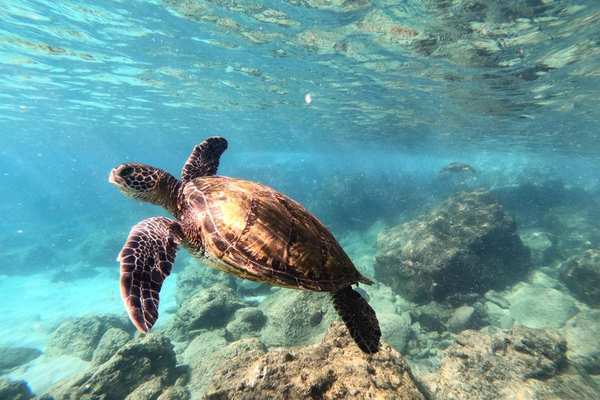
A sea turtle surfacing beside a Florida fishing pier may look like any other dark shape in the water. But its head, shell and location can reveal a great deal. Six sea turtle species occur in US waters: loggerhead, green, leatherback, hawksbill, Kemp’s ridley and olive ridley. Some frequent shallow bays; others cross entire oceans. Learning the differences makes coastal wildlife encounters more rewarding.
This guide focuses on identification clues and the habitats these marine turtles use, from the Atlantic and Gulf coasts to California, Hawaii and US island territories. A sighting offshore does not necessarily mean a species nests on the nearest beach.
How to identify a sea turtle
Start with proportions rather than color. Notice whether the head looks oversized or narrow, whether the shell appears round, oval or ridged, and whether the animal is near a reef, seagrass bed or offshore current. Age, underwater lighting and algae can change its appearance.
Five species have hard shells covered with plates called scutes. The leatherback is the exception. For reliable sea turtle identification, photographs taken from a respectful distance are better than approaching an animal for a closer look.
The six sea turtle species found in US waters
Loggerhead sea turtle
The loggerhead is the broad-headed heavyweight of many US coastal sightings. Look for a large, muscular head, reddish-brown, somewhat heart-shaped shell and strong jaws for crushing crabs and hard-shelled mollusks. Its scientific name is Caretta caretta.
Loggerheads nest extensively along the southeastern Atlantic coast, especially Florida, and also use Gulf beaches. They forage farther north seasonally, including off New England. A hefty turtle with a blocky head off the Carolinas is a good loggerhead candidate, though location alone never confirms identification.
Green sea turtle
Green turtles have a smooth-looking oval shell and relatively small, rounded head. Despite the name, their shells can be brown, olive or patterned. “Green” refers to their greenish fat associated with a plant-rich diet, not a reliably green exterior.
Adults graze on seagrasses and algae in shallow coastal habitats. In US waters, green turtles occur around Florida, the Gulf, Puerto Rico, the US Virgin Islands and Hawaii, with Pacific sightings including Southern California. Juveniles may have different feeding habits. A turtle grazing over seagrass is more suggestive of a green turtle than one cracking shellfish.
Leatherback sea turtle
Nothing else here quite resembles a leatherback. It is the largest living sea turtle, with a dark, flexible, leathery back marked by pale spots and distinct lengthwise ridges. It lacks the hard, plated shell seen in other species.
Leatherbacks specialize in gelatinous prey such as jellyfish. They travel through the Atlantic and Pacific, feeding in comparatively cool waters, including offshore areas near New England and the US West Coast. Some nest in Florida, Puerto Rico and the US Virgin Islands. Their enormous size and ridged silhouette make them distinctive even from a boat.
Hawksbill sea turtle
The hawksbill has a narrow, pointed beak that gives the species its name. Its patterned shell often shows overlapping scutes with serrated edges, although wear and viewing angle can hide these features. The beak is a better first clue than shell color.
Hawksbills are closely associated with tropical coral reefs, where they feed heavily on sponges. In US jurisdictions, look to the Florida Keys, Puerto Rico, the US Virgin Islands and Hawaii rather than assuming they are common along every mainland coast. Never pursue a turtle through coral to confirm an identification.
Kemp’s ridley sea turtle
Kemp’s ridley is among the smallest sea turtles. Adults have a compact body, relatively rounded gray-green shell and a beak suited to feeding on crabs. Unlike the oval outline of a green turtle, its shell can appear nearly circular from above.
This species is especially associated with the Gulf of Mexico, where most nesting occurs on Mexico’s coastline. Some females also nest in Texas. Young Kemp’s ridleys feed along the US Atlantic coast and can travel surprisingly far north. In Gulf shallows, a small, round-shelled animal deserves a look through binoculars, not a closer approach.
Olive ridley sea turtle
The olive ridley completes the US list, although it receives less attention in Atlantic-focused guides. It is small, with an olive-gray, heart-shaped shell. Its numerous side scutes help specialists distinguish it from the similarly sized Kemp’s ridley.
Olive ridleys are mainly ocean-going turtles in tropical and subtropical waters. They occur in the eastern Pacific, including waters off Southern California, and around US Pacific islands; sightings in US Atlantic waters are uncommon. Famous mass-nesting events happen chiefly outside the United States, so a US sighting does not establish a local nesting colony.
Where are sea turtles most likely to appear?
Think in habitats, not just states. Loggerheads and Kemp’s ridleys are familiar possibilities along Atlantic or Gulf shores, while green turtles use sheltered seagrass areas and hawksbills favor tropical reefs. Offshore, leatherbacks and olive ridleys become more plausible. Hawaii and US Caribbean territories add considerably to the diversity of sea turtles in the USA.
Season matters too. Turtles move between feeding and nesting areas, and juveniles may use different habitats from adults. Sea turtle nesting beaches can be protected areas, so marked nests and tracks should be observed from a distance rather than investigated.
What to do when you encounter one
Imagine snorkeling in the Florida Keys when a pointed-beak turtle appears beneath you. Stay still, give it space and let it choose its route. Do not touch, feed, chase or prevent it surfacing to breathe. On beaches, avoid lights around nesting turtles and hatchlings, and follow posted guidance.
All six US sea turtle species are protected under the Endangered Species Act. Fishing-gear bycatch, vessel strikes, marine debris and habitat loss remain major threats. If a turtle is injured, entangled or stranded, contact a local sea turtle stranding network or wildlife authority rather than attempting a rescue yourself. Understanding what sea turtles eat also explains why discarded line and plastics are dangerous.
Frequently asked questions
How many sea turtle species live in US waters?
Six: loggerhead, green, leatherback, hawksbill, Kemp’s ridley and olive ridley. There are seven living species worldwide; the flatback occurs around Australia, not the United States.
Which sea turtle is most common in the United States?
Loggerheads are particularly prominent in southeastern US nesting and coastal waters. The species most likely to be seen depends on location; green turtles may be more conspicuous in Hawaiian feeding areas.
Are sea turtles found off California?
Yes. Green turtles, leatherbacks, loggerheads and olive ridleys can occur in eastern Pacific waters, although numbers and seasonal movements differ. Some are more likely offshore than from a beach.
Can shell color identify a sea turtle?
Not reliably. Lighting, water depth, age and algae alter shell appearance. Combine its shape with head size, ridges or scutes, habitat and behavior.
Recognizing and protecting US sea turtles
For useful identification, record a turtle’s shape, approximate size, behavior and location without disturbing it. Those details tell a richer story than color alone. Protecting these marine turtles means safeguarding reefs, seagrass beds, open-ocean feeding grounds and nesting beaches together.