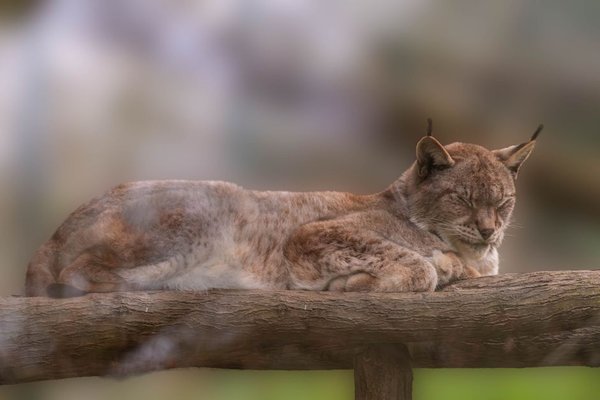
At a glance, a bobcat and a Canada lynx can look like the same secretive forest cat: pointed ears, a short tail, a whiskered face, and a watchful stance. The resemblance is real, but their feet, tail markings, proportions, and location tell a more reliable story than fur color alone.
In North American comparisons, “lynx” generally means the Canada lynx. The Eurasian lynx is a different, often larger species. Here, the comparison is between the bobcat (Lynx rufus) and Canada lynx (Lynx canadensis), two close relatives within the same genus.
Bobcat vs. Lynx: The Quick Identification Guide
Bobcats generally have smaller, proportionate feet, shorter ear tufts, more obvious spots or stripes, and a bobbed tail that is pale underneath. Canada lynx typically have oversized, furry paws, longer black ear tufts, longer-looking legs, a grayer coat, and a tail tip that is black all the way around.
These are tendencies, not an infallible checklist. Individual cats vary, and their coats change with the seasons. A clear view of the tail and paws usually beats an impression of overall size.
Size and Body Shape: Which Cat Is Bigger?
Canada lynx often appear taller and leggier than bobcats, particularly at the hindquarters. Dense winter fur makes them seem substantial, too. Yet the species overlap in weight: a large male bobcat can outweigh a smaller lynx. Size by itself is therefore an unreliable identification test.
Body shape helps more. Bobcats commonly look compact and muscular, with feet that fit their frame. A Canada lynx can seem high-legged, with strikingly broad paws beneath a relatively lean torso. Those proportions become particularly obvious when the cat crosses snow.
Paws and Tracks: The Snowshoe Difference
Some of the clearest bobcat lynx differences are underfoot. Canada lynx paws are broad and heavily furred, spreading weight across soft snow like natural snowshoes. This helps lynx pursue snowshoe hares in northern forests. Bobcat paws are smaller relative to body size, although bobcats can also travel through snow.
Lynx tracks are generally larger, sometimes with soft edges because fur surrounds the pads. Bobcat tracks tend to be smaller and more compact. As a rough reference, bobcat prints are often around 2 inches wide, while lynx prints can reach 4 inches or more. Neither measurement is absolute: the animal’s size, snow conditions, and melting affect prints.
Both species normally leave rounded, four-toed tracks without obvious claw marks, since their claws are usually retracted when walking. Rather than judging one distorted footprint, examine a sequence of undisturbed prints. Compare their width with the depth and texture of the snow.
Tail, Ear Tufts, and Coat Patterns
The tail is often the strongest visual clue
A bobcat tail usually shows dark markings or partial bands, with a pale or white underside near the tip. The Canada lynx has a short tail ending in a solid black tip, including underneath. A photograph showing the underside of the tail can resolve an otherwise difficult sighting.
Ear tufts help, but they can fool you
Long, black ear tufts are characteristic of Canada lynx. Bobcats can also have tufts, generally shorter and less conspicuous. Wind, viewing angle, and low-resolution images affect how prominent they appear, so ear tufts should support other evidence rather than replace it.
Bobcats frequently show dark spotting on their legs, belly, and flanks, with brown or reddish tones. Lynx often look more uniformly gray or frosted, particularly in winter, but some have visible spots. Coat pattern alone is a weak shortcut for wild cat identification.
Habitat and Range: Where Are You Looking?
Bobcats occupy varied habitats from southern Canada across much of the United States into Mexico. They use forests, scrubland, rocky hills, and woodland edges, sometimes close to suburbs where prey and cover remain available.
Canada lynx are more closely associated with boreal forests in Alaska and Canada, plus limited northern and high-elevation areas of the contiguous United States. Deep snow, forest cover, and snowshoe hare habitat help explain their distribution. The species overlap in some regions, however, so geography narrows the possibilities without proving an identification.
A short-tailed wild cat photographed in the desert Southwest is far more likely to be a bobcat than a Canada lynx. In a snowy northern forest, both may deserve consideration.
Hunting: A Specialist and a Generalist
Both cats are mostly solitary predators that stalk and pounce. Canada lynx rely heavily on snowshoe hares, and lynx populations often follow changes in hare numbers. They also take other small mammals and birds.
Bobcats have a broader menu, including rabbits, rodents, birds, and other available prey. This flexibility helps them thrive across a wider range of climates. Their different diets explain much of the habitat distinction, although behavior alone rarely identifies a fleeting sighting.
A Practical Example: A Cat on a Snowy Trail
Imagine a trail camera captures a gray cat crossing a logging road in northern Maine. Its bobbed tail and pointed ears are visible, but the photograph is blurry. Start with the tail: is the tip black underneath, or does a pale patch show? Then examine the feet. Oversized, furry paws and a fully black tail tip favor lynx; smaller paws and a pale lower tail favor bobcat.
If you later find tracks in the area, photograph an entire sequence from above, using a ruler for scale. Record the location and snow conditions. Do not approach or follow a wild cat to confirm the species. Clear photographs and careful measurements are more useful than chasing an uncertain glimpse. A separate guide to wild animal tracks can help you evaluate other clues.
Common Identification Mistakes
Three assumptions frequently cause confusion: that any spotted cat must be a bobcat, that lynx are always heavier, and that bobcats never have ear tufts. None is dependable. Instead, rank the evidence: clear tail underside first, paw proportions next, then legs, coat, habitat, and track details. Compare multiple clues before making a confident call.
Frequently Asked Questions
Is a bobcat a type of lynx?
Yes, scientifically. Bobcats belong to the genus Lynx alongside Canada, Eurasian, and Iberian lynx. In everyday North American conversation, however, “lynx” usually refers to the Canada lynx.
Can bobcats and lynx live in the same area?
Yes. Their ranges overlap in some northern forests and mountain regions. Habitat may suggest one species, but a reliable identification still depends on visible characteristics or clear tracks.
Do both species have ear tufts?
Yes. Canada lynx typically have much longer, more obvious black tufts. Bobcat tufts are often shorter, making them harder to see from a distance.
What is the easiest way to tell them apart?
Look at the tail underside and paw size together. A pale underside near the tip favors bobcat; a solid black tail tip and unusually large, furred paws favor Canada lynx.
Final Thoughts
The most useful bobcat vs lynx comparison is not a contest of which cat looks larger. It is a process of gathering evidence: tail underside, paws, leg proportions, markings, and habitat. Combine those clues, allow for variation, and give wildlife space. That approach makes even a brief encounter much more informative.